
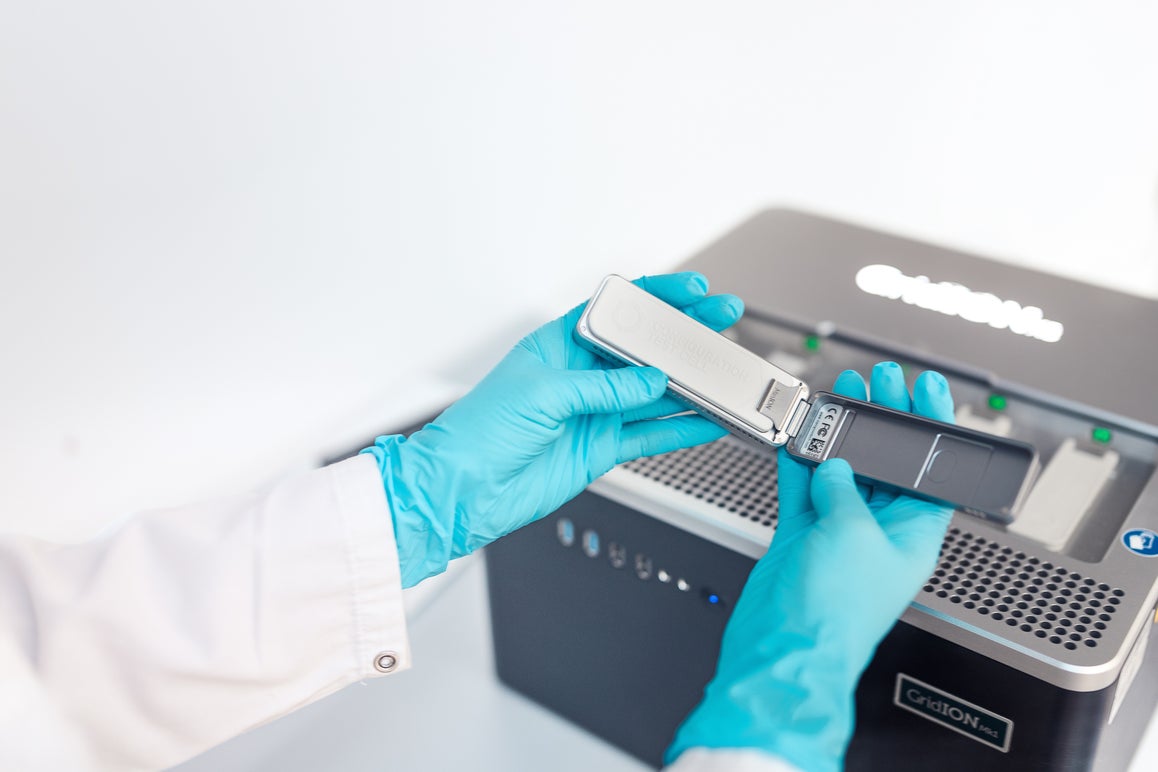
Nanopore sequencing is a novel technology that enables real-time and long-range DNA and RNA sequencing. This technology uses nanopores embedded in an electro-resistant membrane. When DNA strands are passed through these nanopores, they cause a distinct electrical current pattern depending on their sequence. This electric current pattern can be used to determine the DNA sequence.
The technology holds several advantages for HLA genotyping. Its longer read length completely eliminates the problem of phasing ambiguities and offers a higher resolution for the same price. Furthermore, nanopore sequencing is very scalable (from single-sample analysis to high-throughput applications) and a very short sample-to-result time can be achieved.
Therefore, we constantly evaluate the latest developments of flowcells and chemistries for Oxford Nanopore Technologies (ONT) instruments and develop a nanopore specific analysis pipeline for HLA genotyping (Klasberg et al., 2019). Having worked with ONT’s nanopore sequencing technology from the early access stage, we have accumulated substantial hands-on experience. Integrating nanopore sequencing into our laboratory processes is part of our ongoing commitment to innovation.